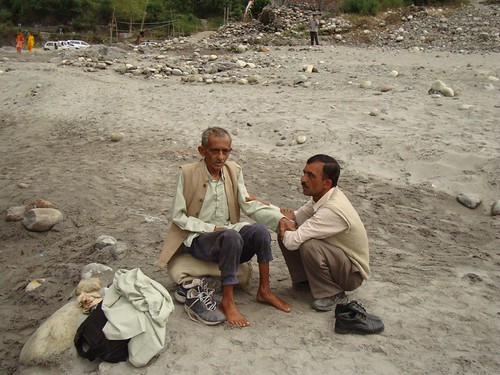
Wednesday, July 2, 2008
Zeenat Mahal - Palace of Beauty
Wednesday, June 25, 2008
Love And All That Jazz
Is it just me, or does anyone else see the irony of an arranged marriage advertisement that promises love?
Perhaps there is a blinding moment of romantic love somewhere during the lengthy process of arranging a marriage? Does love come suddenly tiptoeing in, as families check whether the horoscopes match, whether the bride is fair enough, and the groom comfortably wealthy?
Or maybe love comes later. On the wedding night, perhaps? Maybe there is a very Indian sort of love then; a heady cocktail of flower-strewn beds and dutiful sex, of virginal fumbling and earnest baby-making?
Or does it come still later, as the husband and wife settle into familiar traditions and festivals, and find their place in the larger family? Perhaps when he comes home from work bringing flowers for her hair, their relationship morphs into a real tenderness? Is it then that love develops?
If you ask me, I think the truth is that a very different sort of love develops in Indian marriages - and it is not between the husband and the wife. Parenthood - and the love of children - is the Big Love in an Indian marriage. It seems to me that when a child comes along, many couples put romantic love on the back-burner as they find a fiercer, deeper maternal or paternal love that all but consumes them. The legendary Indian attachment to children burns brighter than anything else, and provides life-long sustenance to the marriage, replacing notions of romantic and sexual love.
Maybe this sort of marriage is really what humans need - a stable, no-nonsense system that creates companionable partnerships, so that we can get on with the real business of making and raising children, populating the gene pool with little copies of ourselves.
Maybe the ancients got it right a long time ago. Why fret and fume over male-female relationships, when really, it’s all about babies?
I am too much a product of Western thinking to be happy with a partnership geared towards childrearing. But Darwin would have approved, don't you think?
Monday, June 16, 2008
The God Question
Try declaring to an uncle or an aunt, that you do not believe in God. Worse still, ask them *why* they believe in a blue-skinned being flying around on a giant eagle saving the world. The initial response is a startled silence, followed by a quick look around to see if anyone else overheard it. This is then followed by much tsking and shaking of the head - "Shhhh...you shouldn't talk like that!", they'll say.
I have a problem with this attitude. What do they mean, "shouldn't talk like that"? It is an honest question, for crying out loud. I get especially upset when people say this to children. If a child asks you a question about God, you owe that child a sensible answer. It may or may not be the right answer, but it is better than giving the child the impression that even *asking* such a question is criminal.
When I was 10, I attended a discussion session organised by a Hindu religious group. In a mixed gathering of children and older people, a middle-aged woman was talking to us about God. When she said "Any questions?", I stood up and asked "But how do you know God exists?". It was a genuine question, I wasn't being cheeky. The speaker smiled at me very condescendingly, and said I was too young to understand, and that when I grew up, it would all become clear. Meanwhile, it would be better for everyone if I just sat down and joined in the prayer.
I sat down, feeling snubbed. I was seething inside. Did my question not deserve an answer, even a small one? It was my first brush with religious tradition, and I remember thinking how closed and narrow it was!
Later, I asked my father the same question. "Appa, why do you believe God exists?". He smiled and said, "Well, I don't really have any proof. But several wise and good men in whom I believe think they have seen and experienced the truth. And because I believe in them, there's a good chance God exists". I was happy with the answer - it gave me something to think about. "Who are these men?", I asked, and it led us into a discussion of Indian philosophers.
The point is not whether my father was right or wrong. The real point is that he gave me a logical answer to his beliefs. It is when people brush aside questions, or spout dogma instead of answers, that I see red.
As I grew older, I made my own observations and deductions. I now believe that we still don't know the real answer to whether God exists, but I've also come to the conclusion that it doesn't really matter. All I want from religion - if anything - is a set of rules to live my life with a clear conscience. And since I have already made up my set of very satisfactory rules, it is not particularly important to me to figure out whether God is for real.
This is not a particularly radical line of thought. Several Indian schools of religion have similar views. Buddhism, for example, is most definitely an agnostic religion. It believes that the eight-fold path of living will lead to salvation, and does not require any belief in a divine being. Mahavira, who founded Jainism, said quite clearly that he didn't believe in a Creator God - he chose instead to believe that the universe has always existed, will always exist and is governed by natural laws.
The Mimamsa school of Hinduism believed that there is a natural Karmic law, where cause and effect apply, with no need of an all-powerful God to enforce the law. Carvaka, who founded a stongly atheistic sect in around 300 BC called the vedas the ramblings of rascals, and said:
While life is yours, live joyously;
None can escape Death’s searching eye;
When once this frame of ours they burn,
How shall it ever again return?
The Rig Veda itself, which modern-day "Vedic" fundamentalists revere as the one authentic source of Hindu religion, says of the creation of the universe:
Who really knows, and who can swear,
How creation came, when or where!
Even gods came after creation's day,
Who really knows, who can truly say
When and how did creation start?
Did He do it? Or did He not?
Only He, up there, knows, maybe;
Or perhaps, not even He.
When you read books of Indian philosophers, it is obvious that we have a great and ancient tradition of religious questioning, of frank open thought. Tragically, the tradition is no longer alive. In its place, we have dogma, backed by political and economical lobbying. The rot has set in, and I fear it is irreversible.
- Deepa
P.S. Whether you believe in flying Gods or not, I think that painting of Vishnu on Garuda is a beautiful example of Bundi art. It is from art.com, and retails for $50.
Sunday, June 15, 2008
Grinding for everyday cooking

These days, I don't see iron mortars and pestles in Indian cities. We've mostly switched to ready-made masalas. You can still see some stone grinders, though.
My mum has a tiny stone mortar-and-pestle, which she uses to make fresh garam masala for cooking. I have a small one too, that I use for crushing garlic, green chili and ginger. Every time a green chili crunches satisfying under the pestle, it awakens something atavistic in me. Take that! I want to say. And that! And that!
My motorised grinder isn't half as fun!
Saturday, May 24, 2008
The Lion People
The Maldharis are buffalo-herders, who live in little mud nesses inside the Gir forest. Like the Masai, the Maldhari count their wealth in cattle. But unlike the Masai, the Maldharis are vegetarian and do not slaughter their livestock for meat. They live instead, by selling milk and milk products, and use the earnings to barter or buy vegetables.
.
Thursday, May 15, 2008
Lemonade Seller, Chandni Chowk
Friday, May 9, 2008
Holiday in the Shivaliks
So - to continue from where the last post left off - I'm just back from a short summer break on the blissfully cool slopes of the lower Himalayas.Naldhera - Abode of God - is 2500 metres above sea level, and a six hour drive from Chandigarh. It is about an hour away from Simla, the capital of Himachal Pradesh.
.
We took a late morning flight to Chandigarh, so we got there when the sun was high in the sky. The heat hit us like a furnace when we got off the plane. The tarmac was hot and dry and blindingly white as we walked towards the airport building to collect our bags. When we got outside the airport building, there was construction everywhere - the place looked like a disaster zone. To add to it, the May heat rose off the newly set concrete in dizzying waves.
.
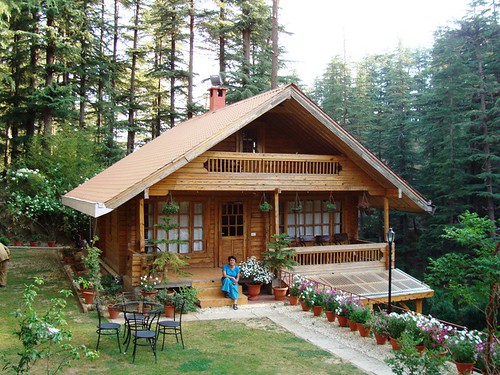
In direct contrast, Naldhera was blissfully cool. When we got there it was dark, so it was only the next morning that I figured out how beautiful the place was. .I sat and listened to birdsong at 6:00 a.m. The trees rose behind the cottage, tall and straight, everything around me was serene and perfect. (Well, almost perfect. By seven thirty, the enlightened management of Chalets Naldhera were piping some very irritating outdoor music on a tinny music system. Can you imagine ruining the peace of this place with bad music?)
The very first thing we did was go on a trek to explore the cedar and pine forests around us. The forest floor was crunchy-soft with needles, and the climb was surprisingly steep. We were rewarded with a view of the Sutlej River as it rushed down below, muddy and swirling with the silt from the upper slopes.
I'd never even heard of Tatta Pani, but it sounded interesting. So the next day, we decided to check it out. Tatta Pani, it turns out, is a little village on the banks of the Sutlej. And "tatta" is localspeak for "tapta" - boiling. Tapta Pani. Very poetic. Conjures up bubbling hot water, doesn't it?We drove about an hour from Naldhera to get to Tatta Pani. The hot sulphur springs right next to the river were an interesting sight, especially because the Sutlej itself is so cold.
The kids had a great time jumping from hot water into cold, and from cold into hot. But Tatta Pani is not all about fun. It is also famous for its curative properties.

Here's the other brother, creating a little impromptu spa. The water was hot, so every now and then, he would dip his hands into the cold river water flowing nearby. Since the going was slow, both brothers joined forces to dig out the pool. They gave each other quiet instructions, and used sticks and stones. I watched them hunched over the sand, patting down mud and stones, and marvelled at how it was both a labour of love and an expression of simple, abiding faith. I was glad I went to Tatta Pani.
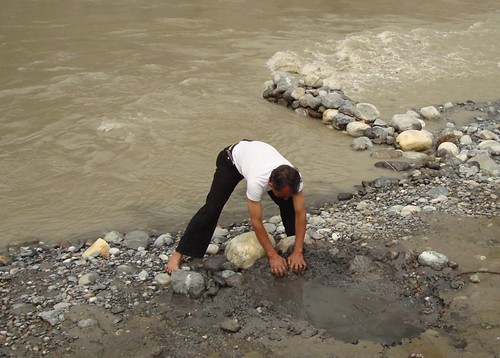
Tatta Pani gets crowded in Jan-Feb (the month of Magha), when large numbers of people come to bathe in the waters. They believe that a dip in this water will wash away all their sins. They also visit the old Shiva cave temple nearby. Another busy day is Baisakhi Day in April.
(Funnily, locals also come here on January 26th, Republic Day, I'm not sure why! Sometimes I think I will never understand this country of mine)
For more tales of Naldhera and Tatta Pani, and my little shopping expedition to Simla, check out my flickr photo travelogue.
Tuesday, May 6, 2008
On the road from Shimla...
Shimla was surprising and interesting in many ways...we stayed at Chalets Naldhera, away from all the bustle of Shimla. More when we get back home!
P.S. It rained last night in Shimla. This morning, the pine and cedar trees were sharp and clear against a blue sky.